Widely considered as Japan's greatest dramatist, Chikamatsu Monzaemon (1653~1724)
spent the mid-part of his career writing kabuki dramas,
although his greatest works were bunraku
puppet plays. When he returned to bunraku, many fans went with
him and kabuki actors began to incorporate elements of bunraku
in an attempt to woo them back. Among the great kabuki dynasties,
the Ichikawa Danjuro line is perhaps the best known and continues to this day. Ichikawa
Danjuro II (1688~1758) premiered many great works and adapted
puppet plays for the kabuki stage. Successors played a huge part
in raising the status of kabuki in society. Other great acting
dynasties include Onoe Kikugoro and Bando Tamasaburo.

The actors who play female roles are known as onnagata or oyama
(such as National Living Treasure Nakamura Jakuemon, left, born in 1920).
As kabuki gained a level of respectability, the importance
of these roles increased. The first great onnagata was Yoshizawa
Ayame I (1673~1729). Many of the great kabuki actors have built
their reputations solely on these roles. The performances are
not so much 'acting' in the Western sense as stylized representations
of female beauty or virtue. While early onnagata were required
to maintain their feminine persona and dress even in their private
lives, this practice was abolished in the Meiji Restoration of
1868.
- Purposes
- Staging
Kabuki is performed on a large, revolving stage and has such familiar
stage devices as scenic backdrops and trapdoors for surprise entrances.
Kamite (stage left) is often where you will see the important or high-ranking
characters, while shimote (stage right) is occupied by lower-ranking characters. Actors
perform kata (forms) as they have been performed throughout the generations.
An example is mie or striking an attitude, often with one's eyes crossed and an
exaggerated expression for dramatic effect.
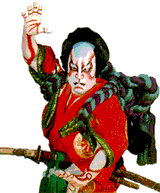 The aragoto or 'rough style' of acting is exemplified by such exaggeration
and dramatic make-up and costume (left). It is associated with
the Ichikawa Danjuro line. Die-hards in the audience join in the
action, calling out the yago (house or family name) of the actors at prescribed moments in
the performance. Standard male kabuki roles include the handsome
lover, the virtuous hero or the evil samurai; for an onnagata,
roles include the high-ranking samurai lady, the young maiden
or the wicked woman.
The aragoto or 'rough style' of acting is exemplified by such exaggeration
and dramatic make-up and costume (left). It is associated with
the Ichikawa Danjuro line. Die-hards in the audience join in the
action, calling out the yago (house or family name) of the actors at prescribed moments in
the performance. Standard male kabuki roles include the handsome
lover, the virtuous hero or the evil samurai; for an onnagata,
roles include the high-ranking samurai lady, the young maiden
or the wicked woman.Traditional kabuki is highly melodramatic but strictly historical. Like the work of Shakespeare, the old stories and characters in the plays are all familiar to those in the know even though the language itself is often antiquated and hard to follow. But while the Bard's masterpieces are still widely popular among all ages, kabuki is no longer of much interest to younger Japanese people. Audiences tend to be made up of older people and refined young ladies. One of the most famous stories, Chushingura - a tale of revenge and loyalty - owes most of its popularity today to its many movie adaptations. Various actors and troupes have worked to incorporate avant-garde elements into kabuki and have worked in other areas such as TV and film. The actors themselves seem to do alright, at least the ones from the famous kabuki dynasties. Their romantic escapades make tabloid headlines and they appear in the odd TV commercial so I suppose there's life in the old art form yet.
 Kabuki is truly a theatrical spectacle, combining form, color
and sound into one of the world's great theatrical traditions.
But as far as dipping your toe into this particular cultural pond
is concerned, a half hour spent at the Kabukiza theater in Tokyo,
Shin-Kabukiza in Osaka or the Minamiza in Kyoto
is probably all you'll need. At Kabukiza, for example,
there is a separate box-office for seats on the 4th floor, where
you can enjoy a single part of the program for as little as 500
yen. Seats for the full program range in price from 2,400 yen
to 16,000 yen. An English "Earphone Guide" is available (except
on the 4th floor) to give you the rundown on what's going on and
also give you a bit of background.
Kabuki is truly a theatrical spectacle, combining form, color
and sound into one of the world's great theatrical traditions.
But as far as dipping your toe into this particular cultural pond
is concerned, a half hour spent at the Kabukiza theater in Tokyo,
Shin-Kabukiza in Osaka or the Minamiza in Kyoto
is probably all you'll need. At Kabukiza, for example,
there is a separate box-office for seats on the 4th floor, where
you can enjoy a single part of the program for as little as 500
yen. Seats for the full program range in price from 2,400 yen
to 16,000 yen. An English "Earphone Guide" is available (except
on the 4th floor) to give you the rundown on what's going on and
also give you a bit of background.
Walang komento:
Mag-post ng isang Komento